Technophysiology: how technology is reshaping us.
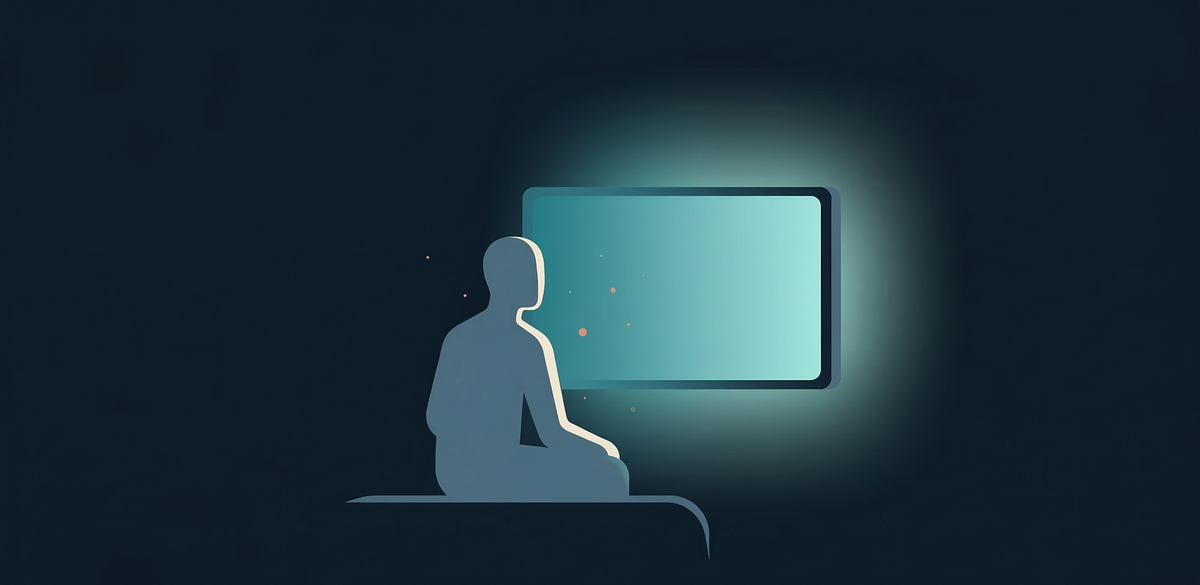
Picture this: a man in a windowless room in the Nevada desert. Coffee on the desk, joystick in hand, monitor glowing in front of him. He moves the stick. A missile is released 10,000 kilometers away.
Then his shift ends. He gets in his car, drives home, helps his kids with their math homework.
As if nothing happened.
That image, the drone operator who goes from a strike to dinner in the time it takes to commute, is uncomfortable for a reason that goes beyond the obvious. Yes, the act itself is disturbing. But the truly unsettling part is what the screen did to the person sitting in front of it. It didn't just give him a weapon. It quietly switched off his moral perception. The distance wasn't just physical, it was ethical.
And here's where it gets interesting for the rest of us, who have never piloted a drone and hopefully never will.
The Myth of the Neutral Tool
We love to think of our devices the way we think of a hammer. You pick it up, drive a nail, put it down. You're the same person you were five minutes ago. The hammer did its job and stayed in its lane.
But that's not what's actually happening with the phone in your pocket.
Researchers who study what they call technophysiology, the way technology interacts with our biology, have found something more interesting and more unsettling. Digital devices are not tools in the traditional sense. They're hybridizing devices. They fuse with the user. They don't just add a function; they quietly redistribute cognitive work between you and the machine, and your brain adjusts accordingly.
Here's a small, boring example that most people have experienced: GPS.
You start using it every day for a couple of years. Life gets easier. Then one afternoon the signal drops and you realize you have no idea how to get to a place you've been to fifty times. The mental map of your own neighborhood has simply dissolved. You didn't notice it happening. There was no moment when you chose to outsource your spatial memory — it just migrated, silently, to the app.
That's not a metaphor. That's a measurable change in how your brain allocates resources.
Pharmakon
The ancient Greeks had a word for this kind of thing: pharmakon. It means, at the same time, both remedy and poison. Gift and trap. The same thing, inseparably.
When early humans learned to cook meat over fire, they gained more calories, fewer diseases, and probably a bigger brain. Extraordinary gift. But once they'd made that biological leap, there was no going back. They couldn't return to raw meat without getting sick. The fire had liberated them — and permanently hooked them.
Forgetting your phone at home today produces something similar to what our ancestors might have felt wandering into unknown territory without fire. An irrational but genuine panic. A feeling of being exposed.
For someone from two generations ago, that reaction would look like a psychiatric episode.
For us, it's Tuesday.
Following vs. Riding
So what do you do with this? You can't smash the servers and move to the woods. And honestly, even if you could, it probably wouldn't help, you'd just find a new pharmakon.
The useful distinction isn't between "technology user" and "technology refuser." It's between two postures toward the wave:
Following it — you get swept along. A new short-video app appears, you're on it for three hours a day within a week. A new AI tool drops, you play with it with no particular goal because everyone else is. The technology sets the agenda; you just show up.
Riding it — you stay upright. You choose what you use, when, and why. You bring the energy of the new thing into your life without letting the wave decide where you end up. This sounds simple. It requires a kind of ongoing discipline that most of us have never been explicitly taught.
There's also something researchers call unlearning — the active dismantling of mental models that were built for a world that no longer exists. In an era where knowledge updates faster than it can be absorbed, the ability to shed old frameworks matters as much as the ability to acquire new ones. Maybe more.
The Question Nobody Is Asking About AI
Here's where I want to leave you with something that's been sitting with me.
We talk a lot about what AI will do to jobs, to creativity, to truth. Important questions, all of them. But there's a quieter question underneath that I think we're mostly avoiding.
Desire, curiosity, the hunger to figure something out, is born from friction. From the gap between what you know and what you want to understand. That restless itch is what drives humans to build things, explore things, change things.
What happens when an AI system is sophisticated enough to anticipate your cognitive needs before you've consciously formed them? When it removes the gap before you even feel it?
No friction. No itch. No hunger.
We might gain efficiency. But I wonder what we quietly lose.
I don't have a clean answer. I'm not sure there is one. But I think it's worth sitting with the question before the technology makes the decision for us.
What are you still willing to struggle through without letting an algorithm pre-digest it for you?
Sources & Further Reading
- Research on GPS use and spatial cognition — see work by Roger Hegarty and colleagues on navigation and hippocampal activity
- The concept of pharmakon in digital philosophy — Bernard Stiegler, Technics and Time
- Technophysiology and cognitive offloading — Smart, Clowes & Ramsden, Cloth Minds (ed.)
- Reports on Web 4.0 and autonomous AI agents — various forecasting publications from MIT Media Lab and World Economic Forum technology anticipation series